

Saxapahaw Water Quality
What you need to know about PFAS in our water system
Key information:
Testing confirmed that PFOA and PFOS contamination in Saxapahaw's water system exceeds federal limits. Village partners are addressing this issue immediately with filtration and a planned system overhaul. Action is underway. The Saxapahaw Utility (full statement below) has stated that preliminary tests have been confirmed, but they have not yet received the official results from the state. “According to the State, these levels are not an immediate risk, and no public agency has released a do-not-drink advisory on this contaminant.”
SAXAPAHAW WATER SYSTEM REPORTS PFAS LEVELS ABOVE FEDERAL LIMITS; COMMUNITY PARTNERS ANNOUNCE TESTING, FILTRATION, AND TREATMENT PLAN
Water sampling at locations served by the Saxapahaw community water system has found two PFAS—PFOA and PFOS—at levels above the federal drinking water standard, according to results released today by the Haw River Assembly, Saxapahaw Water Utility, Saxapahaw businesses, and Hawbridge School.
The organizations are releasing the full laboratory results, a timeline of what was known and when, and a plan to reduce PFAS levels in the system.
THE RESULTS:
Samples were collected at six points on the system on July 31, 2026, and analyzed with validated methods. “Cyclopure is validated to the requirements of EPA Methods 533, 537, and 1633.” The U.S. EPA maximum contaminant level (MCL) for both PFOA and PFOS is 4 parts per trillion (ppt). All six tested locations were above both limits.The source of the contamination is not yet known.
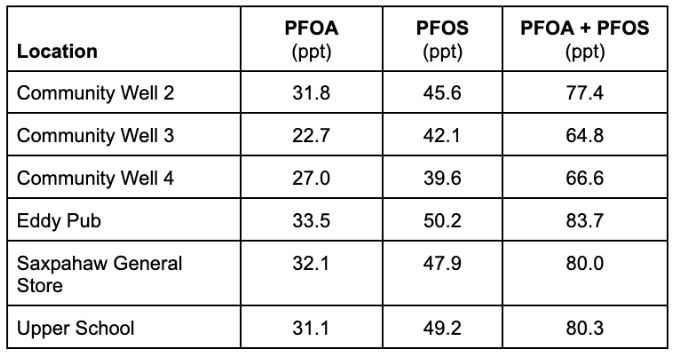
Saxapahaw’s PFOA results ranged from roughly 6 to 8 times the federal limit, while PFOS results ranged from roughly 10 to 13 times the limit. For context, earlier this year the UNC Policy Collaboratory found much higher contamination in Swepsonville and Eli Whitney wells: PFOS at 1289 ppt (roughly 322 times the federal limit) and PFOA at 94 ppt (roughly 24 times the federal limit).
What These Results Mean
EPA drinking water standards set the limit at 4 ppt for PFOA and PFOS based on preventing long-term health effects from chronic exposure. For people in Saxapahaw who drink this water daily, these results (which exceed the limit by 6 to 13 times) represent a serious health concern. The risk is significantly lower for occasional visitors or tourists, since these standards are based on daily exposure over a lifetime. This is why partners are working together to address the issue as quickly as possible.
Right now, there is no official guidance or requirement for utilities to issue consumption advisories. Residents with specific health concerns, particularly those who are pregnant, nursing, or caring for infants, are encouraged to speak with their healthcare provider. PFAS blood testing is available through commercial laboratories, and residents who choose to pursue it can share those results with their provider to discuss what they mean for their own health. Guidance is available from The National Academies of Sciences, Engineering, and Medicine (NASEM) based on your individual test results.
What Happens Next
Partners have committed to the following:
Continued testing. Quarterly sampling across all system points, with every result released publicly. Haw River Assembly will also continue source tracking through PFAS signature studies, which compare the specific mix of compounds found in a sample against known discharge profiles to help identify where the contamination is coming from.
Point-of-use filtration. Installation of certified filters, including reverse osmosis and activated carbon systems that are effective for PFOA and PFOS, for households, businesses, and the school on the system is ongoing. The school is installing a filtration system immediately. Several businesses on the system are beginning to install temporary filters to use until a larger treatment system is in place.Individual households on this well system may wish to treat their drinking water in the short-term using a point-of-use system such as a pitcher filter certified to remove PFOA and PFOS until a point-of-entry treatment system is in place (see link below for NC Health and Human Services certified list of filtration options). Important note: If you purchase a point-of-use filtration system (pitchers or under sinks), Filters on point-of-use filtration systems MUST be changed regularly to be effective. They can even become a source of increased PFAS if improperly maintained. Follow the guidelines from your filter manufacturer when replacing filters in your system.
Point-of-entry systems. Within the next six (update: 6-8 weeks, per Saxapahaw Utility) weeks, point-of-entry filtration will be installed on each public building served by the system, including the apartments, the condos, the businesses, and the school. These units are mounted outside the building where the water line enters and treat all water going into that building for PFAS, not just the water at a single tap. This does not include the cottages and surrounding houses at this time.
A permanent fix. Because Saxapahaw is served by a community water system, it is regulated under the federal Safe Drinking Water Act and must meet the PFOA and PFOS maximum contaminant levels. State funding is available to fully overhaul the drinking water system, which is the long-term solution that will bring the system into compliance and remove PFAS before water reaches any tap. That work is underway but expected to take roughly two years. Filtration is the bridge until it is complete.
Advocacy and accountability. PFAS contamination is not unique to Saxapahaw. It has been found across North Carolina, including Alamance County, and the Haw River Assembly will continue to investigate its sources and hold polluters accountable. Until North Carolina adopts meaningful regulations and sets real limits on PFAS in discharge permits, contamination in this and other communities will continue.
Supporting Saxapahaw and our communities
Saxapahaw is a small community whose mill village businesses employ local people and anchor a place many families depend on. The businesses named in this release did not cause this contamination. They chose to test, they shared their results, and they are paying for filtration.
Partners are asking neighbors and visitors to keep coming to Saxapahaw, keep eating at its restaurants, and keep shopping at its stores. Transparency about water quality and support for local business are not in conflict. This community will be in a stronger position to fix this problem with its businesses intact.
“Our role is to give this community accurate information and the context to understand it. We will continue to be transparent with data and to be clear that this is a long-term, chronic exposure concern Saxapahaw is addressing, with filtration on every building in the next six weeks and a state-funded system overhaul to follow. Haw River Assembly will serve as a liaison between the state, the utility, and business owners as this work moves forward, and we remain a resource for any resident with questions about their water while we continue investigating the sources of this contamination.” - Emily Sutton, Haw Riverkeeper and Executive Director, Haw River Assembly. If you have further questions for Haw River Assembly, please email Emily directly.
“Recent water testing identified PFAS levels above the standard we hold ourselves to. Haw River Ballroom and Cup 22 are installing a certified PFAS filtration system across our water lines – including the line supplying our espresso machine, sinks, and ice machine – this week. We’re a neighborhood gathering place, and we want to assure our community that we’re taking this seriously, acting quickly, and will keep you informed every step of the way - we deeply appreciate the work of Haw River Assembly watching out for the health of our river and community!”
Heather LaGarde, Business Owner, Haw River Ballroom & Cup 22
"The safety and well-being of our students and staff remain our top priority. While additional water evaluations are underway, we have taken several precautionary measures, including providing alternative drinking water, ordering water dispensers for our Lower School, and preparing to install filtration systems for our Upper School fountains. We will continue to monitor the situation closely, work with the appropriate partners, and keep our families and staff informed as we receive additional information and guidance on next steps. Please visit our page at https://thehawbridgeschool.org/water/ for more information and ways to support our school community, or email water@hawbridgeschool.org with additional questions."
Alexis Crumel, Executive Director, The Hawbridge School
Timeline and sampling results:
July 24, 2026: An initial Cyclopure test result showed elevated levels of PFAS in the Saxapahaw system. Saxapahaw Water Utility and local business owners were informed. Because a single sample may not represent levels in the entire water system, and can be affected by collection or handling error, partners moved immediately to confirm it rather than act on one data point.
July 31, 2026: Six locations across the system were resampled to confirm the initial finding and determine whether elevated levels were systemwide. Partners met with state agency staff to plan filtration options.
August 6, 2026: Laboratory results confirmed PFOA and PFOS above the federal MCL at all six locations. Business owners and the school were notified as results came in.
August 12, 2026: Full results released publicly, along with this plan. [Alamance County Health Department / NCDHHS have been notified and are reviewing the data.]
Statement from Saxapahaw Utility Company:
“The Saxapahaw Utility Company is aware of recent preliminary testing indicating the presence of PFAS and PFOS in our water supply at levels that may exceed the new federal drinking-water standards that must be met by April 2029.
While we are awaiting the final results from our state-certified laboratory, we believe it is important to be proactive and take steps now to alleviate and address the issue rather than waiting until the federal compliance deadline.
At this time, no public health agency has issued a do-not-drink advisory for this contaminant, and we are continuing to work with state and federal agencies to determine the appropriate response.
We have already engaged engineers to design a point-of-entry treatment system capable of reducing PFAS and PFOS levels on our primary well, which is capable of supplying all of Saxapahaw with drinking water. Currently, we are pursuing financing to allow us to move forward with this work while longer-term state funding opportunities are evaluated. The final step in our pursuit of construction and installation of these filtration systems is to work with the State of North Carolina to obtain the necessary approvals and permits. As more information is received, we will update the community and keep everyone posted.
We appreciate the community's concern and the willingness to work collaboratively on this issue. Our priority is the long-term safety, reliability, and quality of the water provided to the Saxapahaw community.
We will issue a more detailed update once the final laboratory results and additional information are available.