Publications
Welcome to our publications library, where you can explore four decades of research, advocacy, and community science on the Haw River watershed. From detailed water quality monitoring reports to practical guides for stream stewardship, these resources reflect our ongoing commitment to protecting and understanding the Haw River ecosystem. Whether you're a researcher, landowner, or concerned citizen, you'll find valuable information here about water quality, riparian habitats, climate justice, and the environmental challenges facing our watershed.
Gold Standard Development Practices for Watershed Protection
Print Newsletters:
Our print newsletter has kept members informed about the Haw River watershed for years, documenting environmental challenges, community action, and the ongoing work to protect our river. Past issues available below. If you become a member, our print news will show up seasonally to your mailbox!

-
2007 HRA Newsletters
2006-07 HRA Newsletters
2005 HRA Newsletters
2004 HRA Newsletters
-
2011 HRA Newsletters
2010 HRA Newsletters
2009-10 HRA Newsletters
2008 HRA Newsletters
-
2017 HRA Newsletters
2016 HRA Newsletters
2015 HRA Newsletters
2014 HRA Newsletters
2013 HRA Newsletters
2012 HRA Newsletters
-
2025 HRA (Print) Newsletters
Winter/Spring 2025-2026 HRA Newsletter
Summer/Fall 2025 HRA Newsletter
Spring/Summer 2025 HRA Newsletter
2024 HRA (Print) Newsletters
Winter 2024/2025 HRA Newsletter
Summer/Fall 2024 HRA Newsletter
2023 HRA (Print) Newsletters
Winter 2023-2024 HRA Newsletter
Summer/Fall 2023 HRA Newsletter
2022 HRA (Print) Newsletters
2021 HRA Newsletters
2020 HRA Newsletters
2019 HRA Newsletters
2018 HRA Newsletters
Friday Online E-Newsletters
Stay connected with the latest Haw River news through our Friday email updates. Each week, we share timely updates on river conditions, local environmental issues, upcoming events, volunteer opportunities, and ways to take action to protect our watershed. You can sign up to receive the Friday E-news HERE.

State of the Haw
The State of the Haw is our annual report that provides a comprehensive look at the health of the Haw River watershed. Launched in 2023, this yearly assessment examines water quality data, emerging environmental challenges, conservation successes, and key priorities for protecting our river system. Each report combines scientific monitoring results with actionable insights for our community. Each publication is available via PDF below.
Gold Standard Development Practices for Watershed Protection

We’re excited to share our collaboration with the Waterkeepers Carolina coalition: Gold Standard Development Practices for Watershed Protection, with support from the Southern Coalition for Social Justice. This resource is designed to support community members and local governments advocating for stronger protections for North Carolina’s waterways and the communities that depend on them.
Inside, you’ll find a menu of science-backed, legally viable, and practical policy options that local governments can consider adopting within Unified Development Ordinances or that developers can offer as proffers or in conditional rezoning applications. While not every recommendation will be the right fit for every place, we hope this guide serves as a helpful tool for community members and local leaders working to advance development practices that protect water quality and promote flood-resilient communities.
Questions? Email Emily Sutton, your Haw Riverkeeper and Executive Director at Haw River Assembly
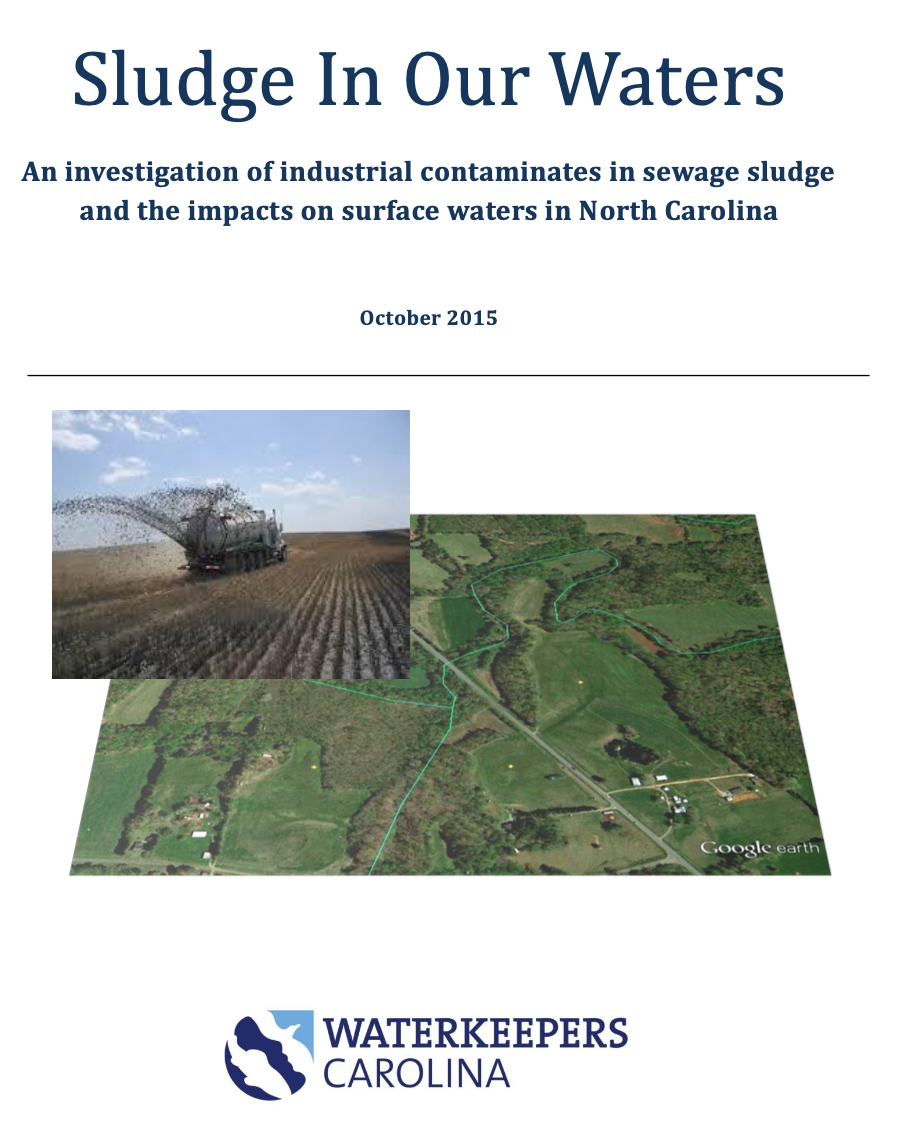
Sludge in surface waters of NC - by Elaine Chiosso and Sam Perkins
Haw Riverkeeper Elaine Chiosso was co-author of the “Sludge in Our Waters” report published by Waterkeepers Carolina, examining how land-applied municipal sludge contains industrial contaminants that pollute streams during storms, including PFAS and 1,4-Dioxane. The report was accompanied by an interactive mapping tool so that people could see location and other data for over 4000 sludge fields throughout the state. The report was made possible by investigations by a team of scientists in our region, led by UNC-CH professor Steve Wing.