

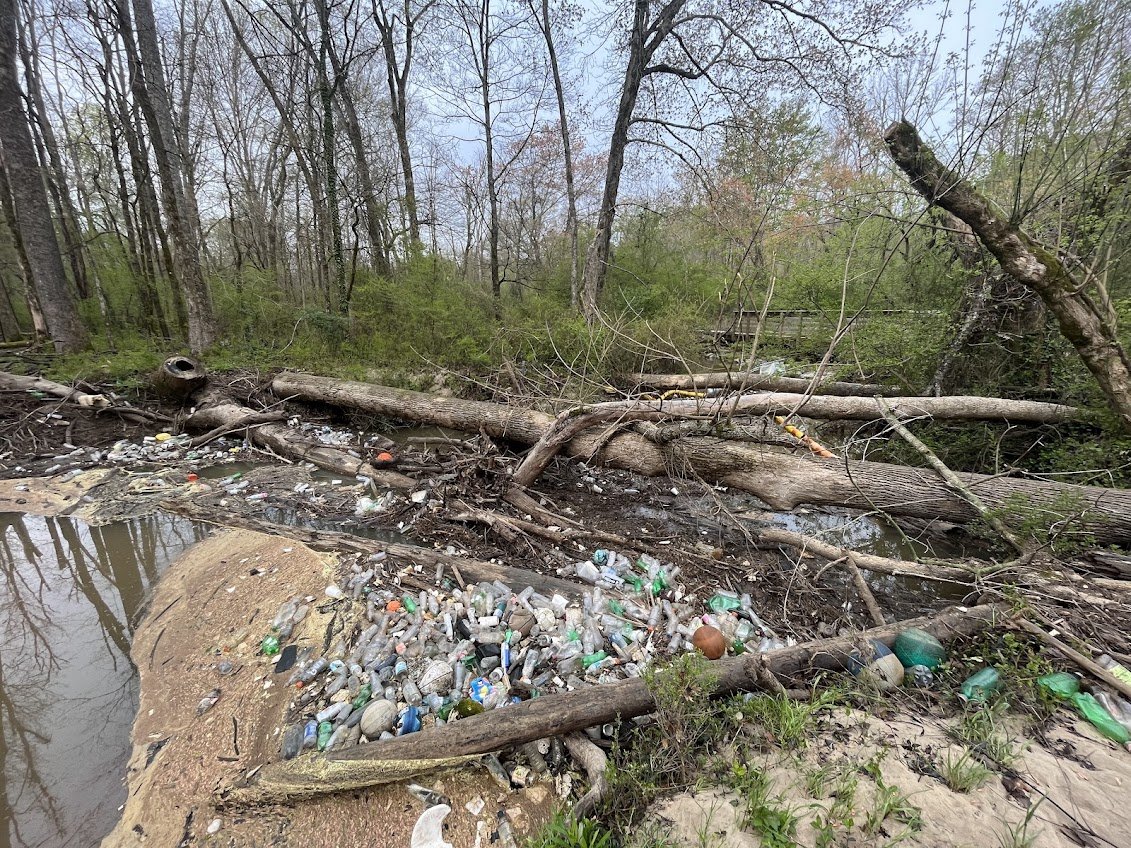
Plastic Pollution
Single-use plastics are everywhere, and too many of them end up in our rivers. These items break down into microplastics that enter our food and drinking water, harm local wildlife, and contribute to climate change. Plastics originate as fossil fuels and emit greenhouse gases throughout their lifecycle, currently accounting for 4-8% of global oil consumption, a number expected to reach 20% by 2050. Haw River Assembly works to address this problem through education, advocacy, and hands-on solutions like our Trash Trap program, which captures litter floating downstream before it can cause further harm. Whether you want to learn more about reducing plastic waste or get involved in keeping our waterways clean, we can help you take action when you volunteer in our Clean-Up-A-Thon and our Trash Trap programs!
Plastics Research on the Haw
We are monitoring microplastics in the Haw River at several locations throughout the basin. This includes downstream of large municipalities like Greensboro, Burlington, Durham, Chapel Hill and Apex. Thanks to a team at UNC Chapel Hill, we will be able to provide you with quantitative data comparing major cities in the Haw River basin for their plastics pollution.

Microplastics Study Measures Impact On Waterways
Durham – Measuring microplastics in North Carolina's waterways is no small job. In collaboration with Waterkeepers Carolina, Haw River Assembly launched a two-year study to collect surface water and sediment samples to understand better the volume of microplastics and macroplastic pollution in North Carolina's streams, rivers, lakes, and bays.
The study "Improving Human and Ecosystem Health through Microplastic Reduction" launched as a collaborative project across 10 nonprofit environmental organizations. To get baselines, 15 Riverkeepers collected two surface water samples and sediment samples. This is the first of bi-monthly samples that will be collected over two years.
To follow this study and learn more about North Carolina's Riverkeepers' work, visit Waterkeepers Carolina - https://waterkeeperscarolina.org.
More recent studies on Microplastics: 1/11/2024
Using newly refined technology, researchers have entered a whole new plastic world: the poorly known realm of nanoplastics, the spawn of microplastics that have broken down even further. They counted and identified these minute particles in bottled water for the first time. They found that, on average, a liter contained some 240,000 detectable plastic fragments 10 to 100 times greater than previous estimates, based mainly on larger sizes. https://www.news-medical.net/news/20240108/Bottled-water-harbors-a-quarter-of-a-million-tiny-plastic-particles-posing-unknown-health-risks.aspx

