Blake Tedder’s Ode to the River: A Storyteller’s Song
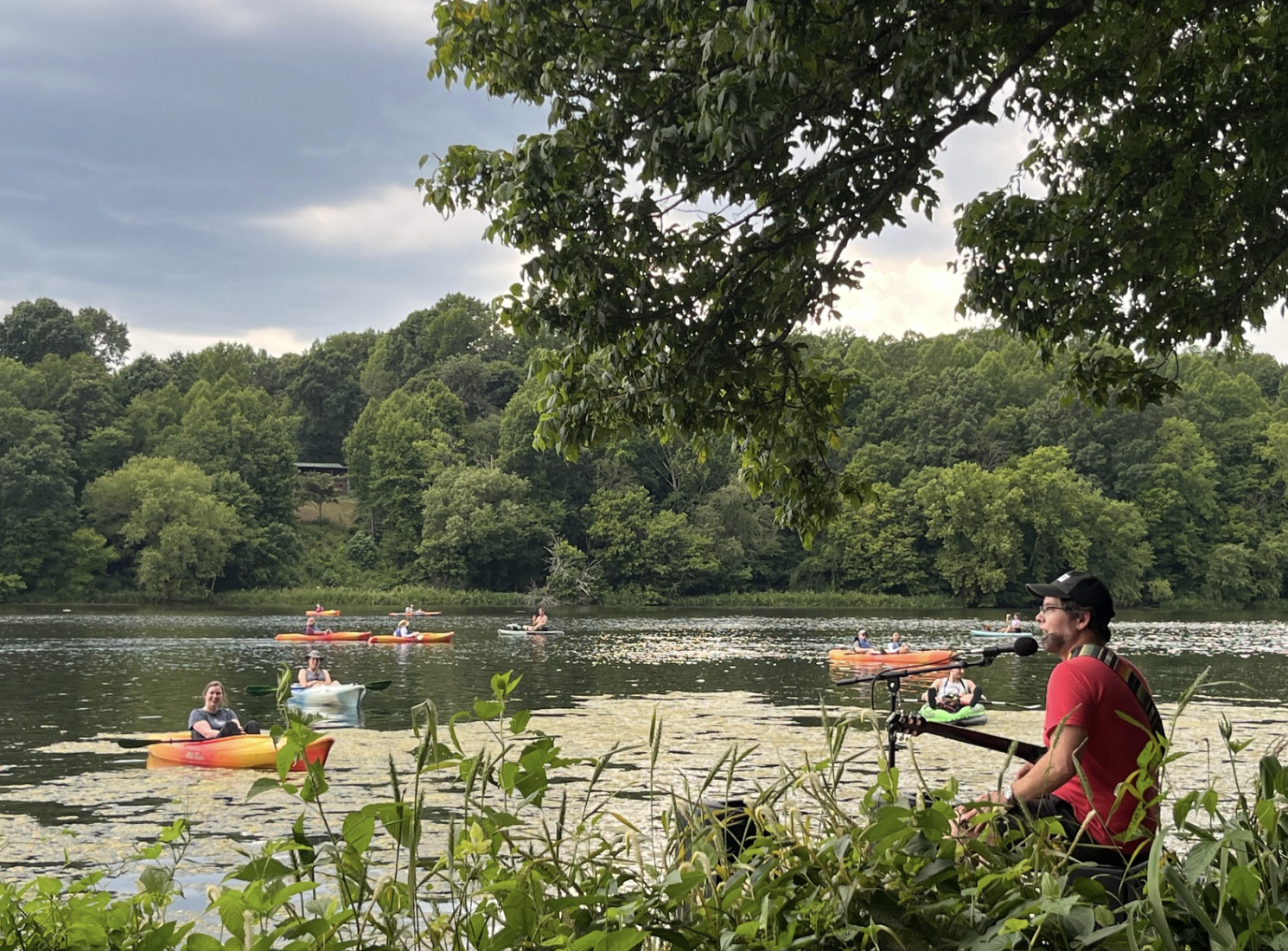
Blake's creative work spans music, writing, and audio production, a range of teaching and community roles including yoga and meditation instruction, chant leadership, podcasting and radio hosting, workshop facilitation, community social work, and nonprofit and higher education administration. This Summer, he returned to performing after years away from the stage. He's also a keeper of river memories. A few years ago, his song-writer and river memorialist collided in a song called "Home," and on a June evening at Hawesome, he played it publicly for the first time, casting the lyrics like a prayer over Saxapahaw Lake to a bunch of people in boats who came because they love the Haw, too.
The song had been floating in his consciousness for five years. You can hear it here.
In his twenties, Blake discovered a simpler world in the midst of everything getting more complex and heavy, right here in Chatham County. He spent days fishing under Chicken Bridge, sitting on rocks to feel the current, floating downstream to Bynum, dreaming of an Allen & Sons sandwich waiting on the other side. He met folks who chose to live close to the land, who built their lives in communion with the river. Parts of Chatham on the Haw River became parts of him, as places and rivers tend to do.
"It's been a personal memorial to the Chatham County," he says. "An incomplete view and a romantic view at that. But it feels true to me."
Development pressures are continuing to arrive. They're arriving locally and nationally. We’re seeing endangered species losing federal protections and clean water regulations being chipped away from us. Blake knows Chatham County’s losses intimately because of his kinship with the river. Everywhere, we are having to confront our losses with each new development, each permanent conversion of land. "The whole thing is deeply sad."
Blake also asks us to consider this: "Who could fault you for wanting to be here?" We're all in this together. The least we can do is share our love and reverence for this place and hope that those virtues seat into the hearts of someone else.
How does a river speak?
Ask Blake if music can move people to care about a place in a way that facts and statistics cannot, and he'll turn the question back on you. Robert MacFarlane, his favorite author, wrote a book titled "Is a River Alive?" It sounds like a sharp question with a sharp answer, but it's not. When we submerge our thinking in the realm of river, our relationship to it changes. We can hear its voice, learn its desires, and we can build a long-term relationship with it. Rivers are living, moving beings with the inherent right to exist, and should be recognized as such.
Blake asks us to begin to recognize the creeks and streams over which you drive every day. Speak them out loud. As I drive around in Alamance County, I have been saying, “Service Creek. Haw River. Cane Creek. Back Creek. Reedy Branch. Motes Creek.” This practice is grounding and takes some paying attention. Slowing down helps, trying to become more present. What can bring you into a deeper, more caring relationship with your watershed? How can you cultivate your curiosity and ask more questions?
One line from "Home" runs like a river through everything: "I've heard it said that the holiest river is your first river, and mine was the Haw. Yes, the holiest river in the world is the Haw."
At Hawesome, Blake talks about his experience sharing his music: "Having Saxapahaw Lake as a venue was extraordinary," he said. "What an honor to cast those words like a prayer over this special and beautiful and holy river, and to have it heard and felt by other river lovers in the river herself. After all, those lyrics came to me because of the time I have spent with the river. Circles upon circles make spirals."
He played Hawesome again in August, bringing the song back to the place it belongs. On both of those afternoons, the people weren’t the only ones listening. Everything was listening. Learn more about Blake at his website HERE. Thank you Blake, onward and upstream.