

Cold War Legacy Contamination in a Low-Income Community of Color
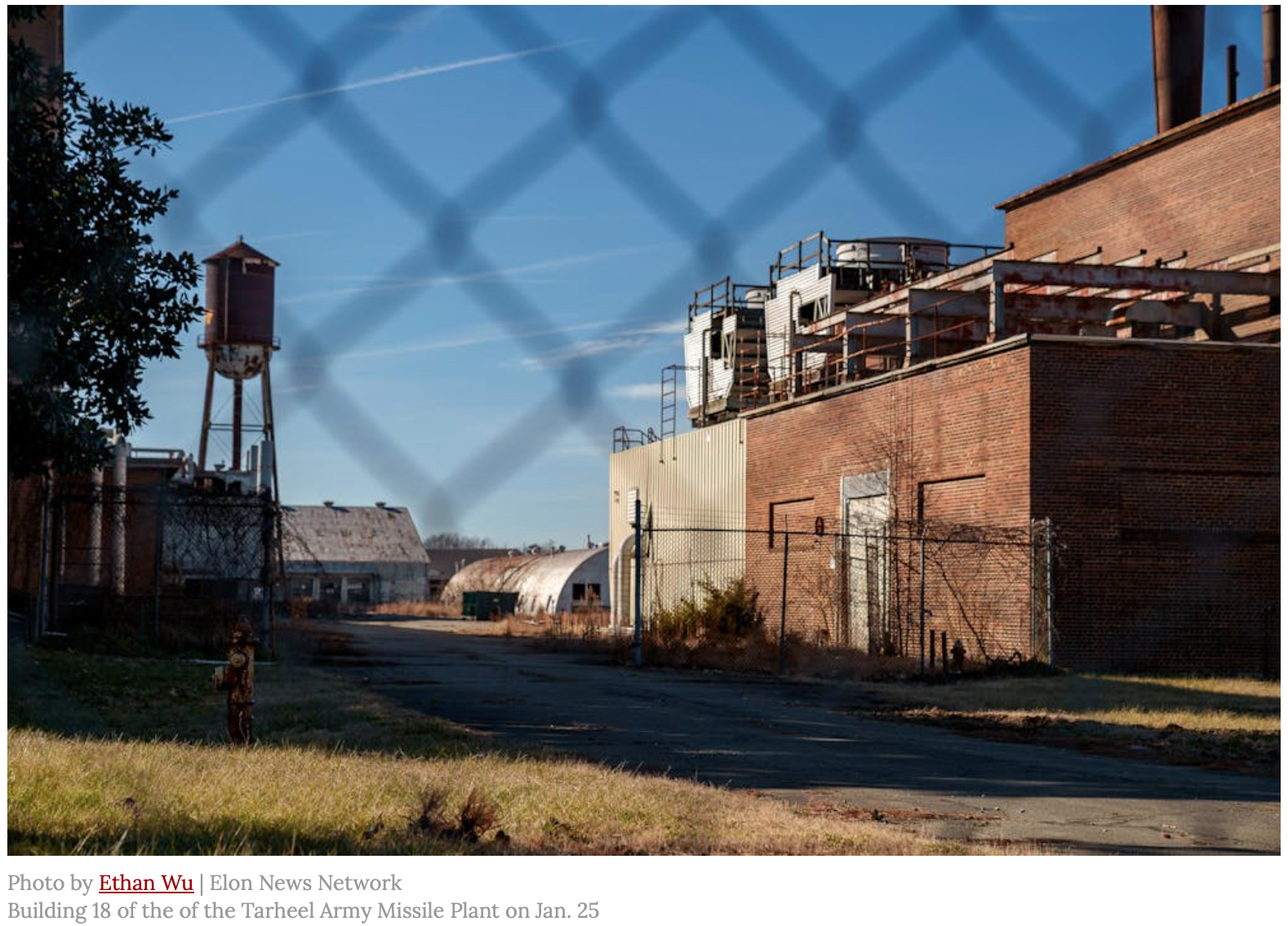
Tarheel Army Missile Plant - Burlington, NC
The future of the Tarheel Army Missile Plant and the pollution it has left behind in East Burlington is of serious concern for Haw River Assembly. The plant (also called Western Electric) has affected the air and groundwater in this neighborhood for decades. This is a community made up of mostly of Black, Hispanic, and low-income families. Many residents' first language is not English. The plant sits directly next to a popular local restaurant where elderly residents and neighbors come together to eat.
During the Cold War, this site is where Nike Missile guidance systems were secretly built. Testing has found high levels of cancer-linked chemicals in the groundwater, soil, and stormwater runoff, including TCE, PCE, benzene, and vinyl chloride. For decades, this site has been a source of concern, distrust, and environmental injustice, fueled by falsified documents, cover-ups, and criminal offenses by the current property owner. The community's skepticism about how this site has been handled is clearly justified.
Jalonne White from the Council on Environmental Quality at the White House committed to coordinating cleanup efforts between the Department of Defense, EPA, Superfund and Brownfield Programs, Department of Energy, and the National Institute for Environmental Health Sciences. A contract was signed to address the contaminated groundwater underground.
According to the US Army Corps, Department of Defense (DoD), NCDEQ (North Carolina Department of Environmental Quality), and City of Burlington, the contamination does not pose an immediate danger to the surrounding community. TCE (Trichloroethylene) is an industrial degreasing chemical that has contaminated the soil and groundwater at the site. Residents in the neighborhood get their water from Burlington's city system, which has not been contaminated. However, there is a concern that chemicals in the groundwater could turn into vapors and seep into nearby homes, a process called vapor intrusion. Testing has been done outside homes in the area, and so far, nothing concerning has been detected. TCE from the groundwater has also made its way into a nearby creek, where it has been found in the sediment and surface water. TCE breaks down and evaporates within 7 to 10 days when exposed to air, but to be safe, no one should swim, wade, or splash in that creek. To stop the contamination from spreading further, iron has been injected into the ground to create a 75-foot-wide barrier wall, and microbes have been introduced to break down the remaining TCE. The Department of Defense has also removed around 500 tons of contaminated soil to keep more chemicals from reaching the groundwater. That soil was transported to a landfill site that accepts toxic waste.
History of the Site
The site was built in 1927 as a rayon manufacturing plant. It failed financially and closed in 1931. In 1942, the Defense Plant Corporation purchased the property for wartime manufacturing, including training aircraft components. After WWII, Western Electric Company took over operations and, by the late 1950s, began producing guidance systems for Nike surface-to-air missiles under the U.S. Army's Missile Command. At its peak, nearly 4,000 people worked at the plant, making it Burlington's largest employer. Workers routinely handled dangerous chemicals, including TCE, PCE, and chrome plating compounds, with little environmental oversight. In the 1970s, a worker poured radioactive Cesium-137 down a sink drain. The plant wound down after the SALT treaties (Strategic Arms Limitation Talks) and the Department of Defence eventually sold the property in 2004.
Throughout the 1980s and 1990s, the Army minimized the contamination, concluding that thorough investigation was unnecessary, even though the bulk of waste disposal records were missing or never kept. The Army lobbied the EPA to keep the site off the Superfund list, and in 1994 it scored too low to qualify, based on incomplete data. Just three years later, a state official observed contaminated groundwater migrating off site and warned that a catastrophic chemical release may have occurred. Without Superfund status, the community had no legally required public meetings and no access to technical assistance grants.
Since 2004, the property has passed through four private owners. The current owner, David Tsui, purchased the site in 2018. Records show Tsui previously pleaded guilty to federal criminal counts for Medicare fraud. Under his ownership, unpermitted demolitions, leaking waste barrels, and building deterioration have been documented. In 2023, Army Corps contractors discovered PFAS in groundwater at levels hundreds to thousands of times above proposed state standards, but the military failed to inform NCDEQ. A Cold War-era tunnel beneath the plant was also identified as an additional contamination source.
Environmental Justice and What This Means for East Burlington Residents
According to a 2018 Alamance County health assessment, people living in East Burlington have a life expectancy 11 years shorter on average than the surrounding area. Most of the homes near the plant are rentals, including houses, apartments, HUD housing, and trailer parks, with families moving in and out frequently. Many residents have no idea about the contamination in their neighborhood. Chemicals from the site have made their way into a nearby stream that feeds Service Creek, a tributary of the Haw River. While the contamination is not in the drinking water, children play in these streams, animals drink from them, and when the streams flood, residents in the area are directly exposed.
How Haw River Assembly Is Involved
Haw River Assembly sits on the TAMP Restoration Advisory Board and works alongside the West End Revitalization Association (WERA) and community advocates to make sure the cleanup is done right and that the community has a seat at the table. Haw Riverkeeper and Executive Director Emily Sutton has independently sampled the neighborhood stream for PFAS. We will continue to monitor this site and fight for the health of East Burlington residents and the Haw River watershed.
Where Did the Contaminated Soil Go?
According to the Terracon Interim Action Completion Report (August 2024), contaminated soil and waste from the TAMP excavation was sent to three facilities:
Upper Piedmont Environmental Landfill, Rougemont, NC (Person County): 404.84 tons of non-hazardous soil. This Republic Services landfill has faced community opposition over its expansion and its acceptance of contaminated soils from other cleanup sites, including PCB-contaminated soil from the Ward Transformer Superfund site. During public hearings, residents raised environmental justice concerns about the landfill's impact on their community. Its leachate is sent to the City of Burlington's wastewater treatment plant for disposal.
US Ecology Wayne Disposal, Belleville, MI (Wayne County): 56.80 tons of hazardous soil. This 600-acre facility has faced intense public opposition in recent years after residents learned it was receiving radioactive waste from Manhattan Project cleanup sites managed by the U.S. Army Corps of Engineers. Michigan's environmental justice screening tool ranks the surrounding area in the 83rd percentile for overall environmental justice concerns and the 98th percentile for environmental effects. The facility is currently seeking to expand vertically.
Clean Harbors Reidsville, LLC, Reidsville, NC (Rockingham County): approximately 4,200 pounds of TCE-contaminated hazardous sludge. This is a transfer and storage facility, not a final disposal site. Waste consolidated here is shipped to Clean Harbors-owned treatment and disposal facilities in other states. Reidsville is a city of about 14,600 people where 32% of residents are Black, the poverty rate exceeds 21%, and the child poverty rate is 38.2%. The median household income is roughly $42,900, which is about two thirds of the North Carolina state median. Since Clean Harbors in Reidsville is only a transfer point, there is technically a fourth community somewhere finally receiving that sludge. Something for us all to chew upon, which leads us to one conclusion of many:
Why This Matters: We are all upstream and downstream of someone.
When contamination is cleaned up in one community, it does not disappear. It gets loaded onto trucks and driven to another community, often one that is low-income, rural, or predominantly made up of low-income communities and people of color. The soil that sat beneath this plant in East Burlington for decades is now buried in Person County and Belleville, Michigan. The families living near those landfills did not work at Western Electric. They did not benefit from the Cold War jobs. However, they are living with the waste. This is how environmental injustice works. It does not get solved. It just gets relocated and it will keep getting relocated until we change the way we produce, consume, and dispose of the things we use every day. Every chemical we manufacture, every solvent we flush, every product we throw away ends up somewhere. It ends up in our groundwater, in our streams, in the Haw River, in someone's backyard or in someone’s body. The only real solution is to stop creating the problem in the first place, to demand alternatives to these toxic substances, to hold polluters accountable before the damage is done, and to remember that "away" is always someone else's home.
Sources and Further Reading:
Interim Action Completion Report: Source Area Excavation, Terracon Consultants / Northwind-Jacobs Joint Venture: Discusses what was found, how the toxic waste was managed and locations to which the hazardous waste was sent. August 15, 2024
Technical Assistance (TA) Document: NC DHHS recommendations for the TAMP site and surrounding community, April 2025
RAB Meeting Minutes Thursday, 3 October 2024: Community Involvement Plan, Property Transfer Overview, NCDEQ Regulatory Review Process, Next Steps
RAB Meeting Minutes Thursday, 4 December 2024: Schedule of Restoration Activities
RAB Meeting Minutes Thursday, 17 April 2025: Waste Disposal & Community Trust: Concerns included the long timeline of cleanup, the adequacy of historical data, and whether residents had been fully informed in the past. The community asked for more transparency on how disposal sites were selected and approved.
RAB Members List: Western Electric / former Tarheel Army Missile Plant (TAMP) RAB Members
A Former Army Missile Plant Has Polluted a Black, Latino Neighborhood for More Than 30 Years, INDY Week / Lisa Sorg, 2021 (Part 1)
Former Army Missile Plant in Burlington Poses an Urgent Public Health Risk, INDY Week / Lisa Sorg, 2021 (Part 2)
Air Testing Planned for Neighborhood Adjacent to Contaminated Former Missile Plant, NC Newsline / Lisa Sorg, January 2022
Tunnel Below Old Tarheel Army Missile Plant Contains Toxic Contamination, NC Newsline / Lisa Sorg, June 2023
Too Big to Dismantle: Planning for Reuse of the TAMP, Carolina Planning Journal / Ian Baltutis, January 2023
Superfund Decision for Tarheel Army Missile Plant Relied on Incomplete Data, NC Newsline / Lisa Sorg, March 2024
PFAS Found Beneath Tarheel Army Missile Plant, Military Failed to Tell DEQ, NC Newsline / Lisa Sorg, April 2024
U.S. Army Bivouacs at Burlington Rec Center to Brief Residents on Western Electric Cleanup, Alamance News, June 28, 2024
Army Makes Progress Clearing Old Burlington Missile Plant, WFMY News 2, March 2024
East Burlington Residents Fight for Environmental Equity, Elon News Network, February 2025
East Burlington Comes Together to Protect Equity, Provide a Voice, Elon News Network, April 2025
Meeting Held to Discuss Cleanup of Former Western Electric Site in Burlington: FOX8 WGHP, July 23, 2025
ProPublica - Bombs in Your Backyard: Tarheel Army Missile Plant
National Register of Historic Places Registration Form, NC Department of Natural and Cultural Resources, March 2016
Wikipedia - Western Electric Company-Tarheel Army Missile Plant