PFAS Detected in Eli Whitney Fire Station Well: What You Need to Know
More PFAS contamination in Alamance County wells:
Tuesday, February 10 @ 7pm Community Meeting
February 6, 2026: (Stay up to date and sign up for our Voice of the Haw E-news)
“High levels of PFAS have been found in the Eli Whitney Fire Department's well water, raising concerns about nearby residential wells. Tests found PFAS levels above 1,000 ppt (parts per trillion). For comparison, the EPA's drinking water limit is 4 ppt.
The fire department has immediately switched to tanked-in, food-grade water for the fire station and community building while working with the North Carolina Collaboratory to find a long-term solution. The contamination was discovered through a statewide firefighting research program authorized by the NC General Assembly in 2023.
Homes adjacent to the fire station may qualify for free well testing through NCDEQ (North Carolina Department of Environmental Quality). If elevated PFAS levels are found, homeowners may also qualify for in-home water filtration.
Residents will hear from subject matter experts and learn more about PFAS. We know how unsettling this news is for our neighbors who depend on their well water. We'll continue working to ensure everyone in our watershed has access to safe, clean drinking water and keep you updated about this issue.”
February 11, 2026 UPDATE:
On Tuesday, February 10*, PFAS experts from NC DEQ (Department of Environmental Quality), NCDHHS (Department of Health and Human Services), the NC Collaboratory and Alamance
County Health Department spoke with community members in Eli Whitney (Southern Alamance) after finding highly elevated levels of PFAS at the local fire station well.
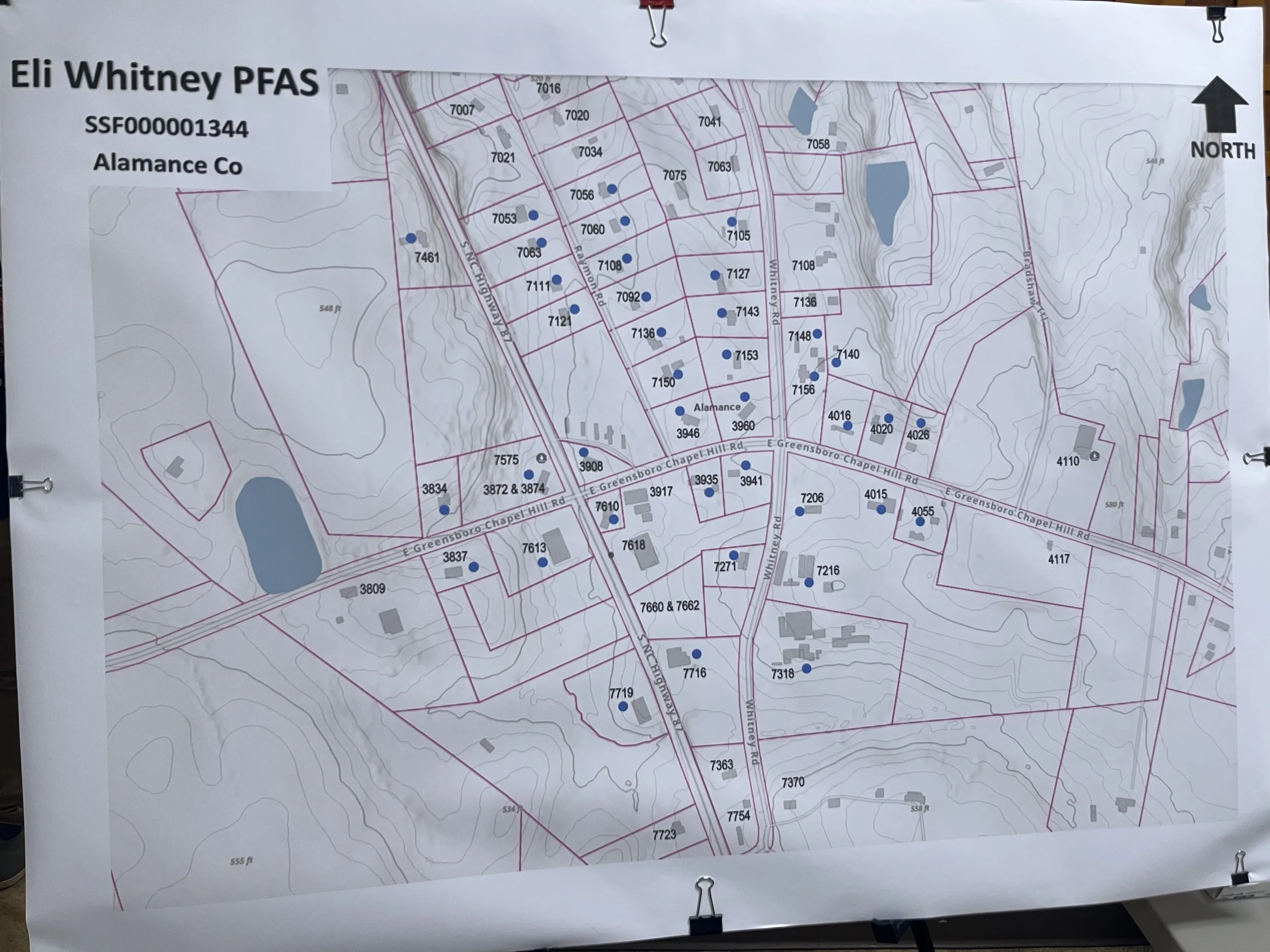
Properties indicated with blue dots are those contacted for the first round of private well testing.
WHAT'S HAPPENING?
The Collaborative's research program has tested 411 rural fire stations in NC.
In Eli Whitney's volunteer fire department well, they found PFOS at 1289ppt, PFOA at 94ppt (ppt = parts per trillion). EPA maximum contaminant levels for municipal drinking water are 4ppt for PFOS and PFOA. Of the other seven NASEM compounds, PFHxS: 158ppt, PFNA: 6ppt, PFDA: 2ppt, PFuDA: Non-detect, and MeFOSA: Non-detect. (See “NASEM” information below.)
AFFF (aqueous film forming foam containing PFAS chemicals) has been determined to be the most likely culprit for contamination in the Eli Whitney fire department well.
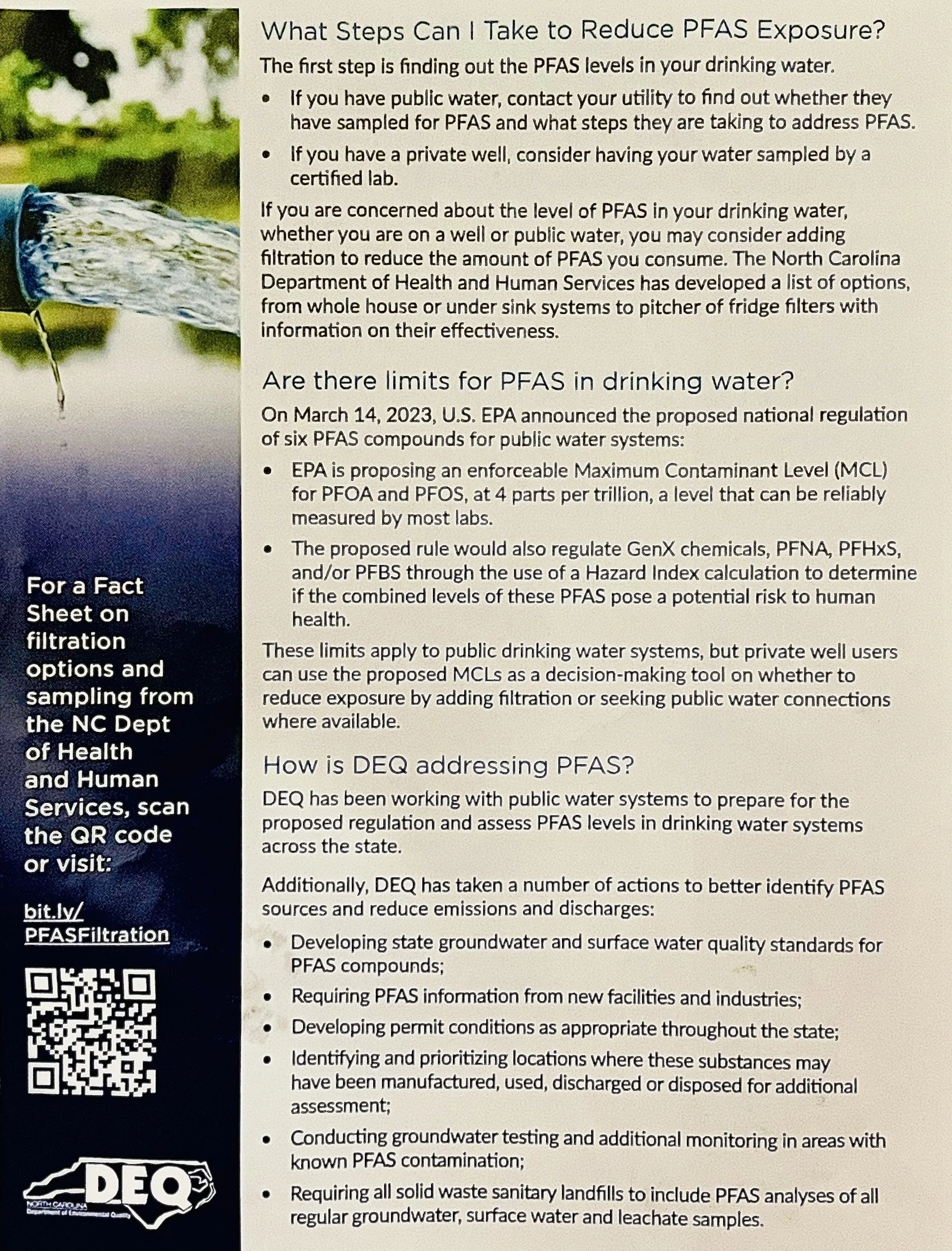
Letters have been sent to 32 properties of most concern nearby the fire station. Testing will begin mid to late February and results should return by mid-March.
Homes located next to or near the fire station may be eligible for complimentary well testing, based on their location and assessed risk.
If wells tested have PFAS levels exceeding the EPA limit of 4 parts per trillion, homeowners will be eligible for in-home, under-sink water filtration systems (runs $3,500). (IF YOU WANT A DIFFERENT OR WHOLE HOUSE FILTER, YOU MUST PROVIDE THE DETAILS ABOUT THAT FILTER TO NCDEQ AND IF IT QUALIFIES AS A REPUTABLE FILTRATION SYSTEM, THE $3,500 WILL BE PROVIDED TO SUPPLEMENT THAT COST.)
Link to Alamance County Website for Eli Whitney: https://eh.alamancecountync.gov/eli-whitney-pfas-information/
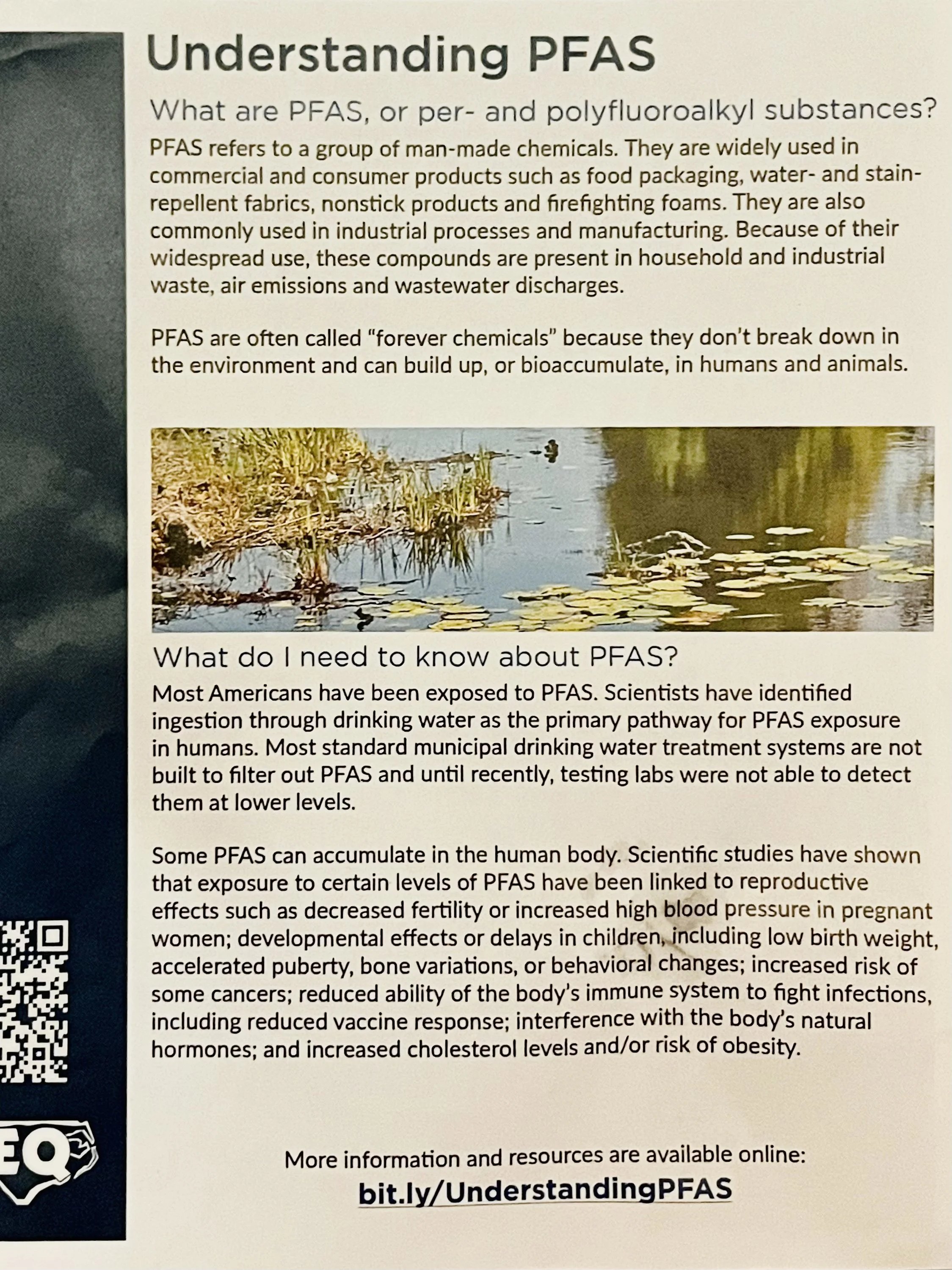
High levels of PFAS exposure can lead to diseases of the liver, thyroid, pancreas, decreased immune system function, developmental issues, high cholesterol, low birthweight, hormone disruption, and several types of cancers including testicular, thyroid, breast and kidney.
FINDINGS LIKE THESE UNDERSCORE THE URGENCY OF HAW RIVER ASSEMBLY’S WORK TO ENSURE CLEAN DRINKING WATER FOR ALL NORTH CAROLINIANS.
BEST PRACTICES TO REDUCE PFAS EXPOSURES from Garden-Grown Produce in Areas with Contamination: https://epi.dph.ncdhhs.gov/oee/docs/PFAs_gardening_factsheet_11152024_sm.pdf
PFAS WATER TESTING AND FILTRATION RESOURCES: https://epi.dph.ncdhhs.gov/oee/pfas/PFAS_TestingFiltration.pdf
NCDEQ PFAS Treatment System Assistance Program: https://www.deq.nc.gov/pfas-treatment-system-assistance-program. Request testing through this program here.
MEETING HANDOUTS AND FURTHER INFORMATION FOR BOTH OUR ENGLISH AND SPANISH SPEAKING NEIGHBORS:
(NASEM 2022 guidance, the seven PFAS compounds currently being measured in the National Health and Nutrition Examination Survey are:
PFOA (perfluorooctanoic acid)*
PFOS (perfluorooctanesulfonic acid)*
PFHxS (perfluorohexanesulfonic acid)
PFNA (perfluorononanoic acid)
PFDA (perfluorodecanoic acid)
PFuDA (perfluoroundecanoic acid)
MeFOSA (Methyl-perfluorooctane sulfonamide)
These are the seven PFAS compounds that NASEM identified as priority for clinical testing and monitoring. They're considered some of the most prevalent and concerning PFAS due to their widespread use in industrial applications and consumer products, and their persistence in the environment and human body. (Located on page 1 of the NASEM 2022 guidance document.)
The EPA has since regulated five specific PFAS compounds for drinking water as of April 2024: PFOA, PFOS, PFNA, PFHxS, and HFPO-DA (also called “GenX” see more about the October 2017 lawsuit’s most recent update about Chemours from NC Health News), so these remain central to water quality monitoring and contamination concerns.
NASEM Guidance Highlights (Summary): https://bennertownship.org/wp-content/uploads/2024/08/NASEM-PFAS-Guidance-Highlights-002.pdf
Interactive Report from National Academies Press: https://nap.nationalacademies.org/resource/26156/interactive/
EPA/VA Public Health PFAS Information: https://www.publichealth.va.gov/exposures/pfas.asp
ENGLISH HANDOUT:
Why was the Eli Whitney Fire Station well water tested?
As part of a statewide firefighting research program passed by the legislature in 2023 (SL 2023-134), the NC Collaborative tested water wells at 411 rural fire stations across North Carolina for PFAS (per- and polyfluoroalkyl health concern.
What did the well water testing find?
The Eli Whitney Volunteer Fire Department well (7618 Hwy 87 South, Graham) showed one or more PFAS results above 1,000 parts per trillion (ppt).
Why is this important?
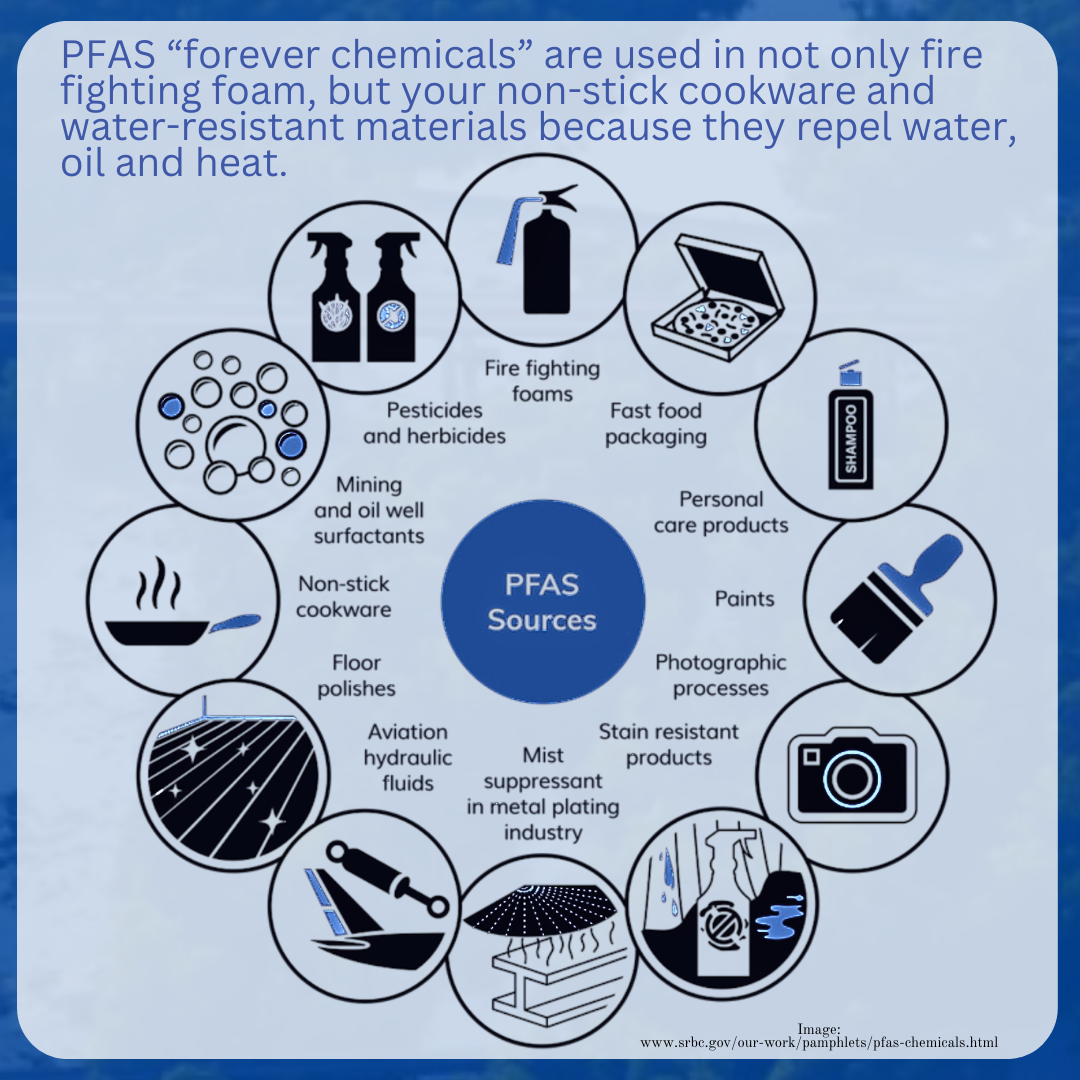
PFAS are a large group of man-made chemicals that are widely used and long-lasting. They are found in products such as nonstick cookware, firefighting foam, and water-resistant materials because they repel water, oil, and heat.
PFAS breaks down very slowly over time and can build up in people and the environment. Some PFAS are linked to health problems, which is why they are often referred to as "forever chemicals."
What immediate steps are being taken?
Alamance County has consulted with several subject matter experts and is taking the following immediate actions:
Community meeting: A community meeting is being held on February 10, 2026, at 7:00 p.m. to inform residents in the immediate area of the recent findings and planned next steps.
Well Water Testing: Within the next two weeks, NC DEQ will be mailing letters to property owners on adjacent area properties of the initial sampling location, offering PFAS well water testing at no cost to the owner.
Communication: Alamance County Health Department and NC Department of Environmental Quality (DEQ) are committed to keeping you informed as we receive additional information.
If you have questions regarding:
PFAS well water testing: please contact Vincent Antrilli (919) 707-8353 vincent.antrilli@deq.nc.gov
PFAS exposure health effects: please contact Kennedy Holt (919) 715-2632 Kennedy.Holt@dhhs.nc.gov
Eli Whitney PFAS Information webpage:
https://eh.alamancecountync.gov/eli-whitney-pfas-information/
SPANISH HANDOUT:
¿Por qué se analizó el agua del pozo de la Estación de Bomberos Eli Whitney?
Como parte de un programa estatal de investigación sobre extinción de incendios aprobado por la legislatura en 2023 (SL 2023-134), la Colaborativa de Carolina del Norte analizó pozos de agua en 411 estaciones de bomberos rurales de Carolina del Norte. Las pruebas incluyeron el análisis de 41 compuestos de PFAS, incluyendo aquellos con mayor evidencia de riesgo potencial para la salud.
¿Qué se encontró en el análisis del agua del pozo?
El pozo del Departamento de Bomberos Voluntarios de Eli Whitney (7618 Hwy 87 South, Graham) mostró uno o más resultados de PFAS superiores a 1000 partes por billón (ppt).
¿Por qué es importante?
Las PFAS son un amplio grupo de sustancias químicas sintéticas de uso generalizado y larga duración. Se encuentran en productos como utensilios de cocina antiadherentes, espuma extintiiva y materiales resistentes al agua, ya que repelen el agua, el aceite y el calor. Las PFAS se descomponen muy lentamente con el tiempo y pueden acumularse en las personas y el ambiente. Algunas PFAS están relacionadas con problemas de salud, por lo que a menudo se las conoce como "sustancias químicas permanentes".
¿Qué medidas inmediatas se están tomando?
El Condado de Alamance ha consultado con varios expertos en la materia y está tomando las siguientes medidas inmediatas:
Reunión comunitaria: Se celebrará una reunión comunitaria el 10 de febrero de 2026 a las 7:00 p.m. para informar a los residentes de la zona sobre los hallazgos recientes y los próximos pasos planificados.
Análisis de agua de pozo: En las próximas dos semanas, el Departamento de Calidad Ambiental de Carolina del Norte (DEQ) enviará cartas a los propietarios de las propiedades adyacentes al lugar de muestreo inicial, ofreciendo análisis de agua de pozo para detectar PFAS sin costo alguno.
Comunicación: El Departamento de Salud del Condado de Alamance y el Departamento de Calidad Ambiental de Carolina del Norte sus siglas lo indican (DEQ) se comprometen a mantenerlos informados a medida que recibimos información adicional.
Si tiene preguntas sobre:
Análisis de agua de pozo con PFAS: comuníquese con Vincent Antrilli (919) 707-8353 vincent.antrilli@deq.nc.gov
Efectos en la salud por exposición a PFAS: comuníquese con Kennedy Holt (919) 715-2632 Kennedy.Holt@dhhs.nc.gov
Eli Whitney PFAS Information webpage:
https://eh.alamancecountync.gov/eli-whitney-pfas-information/