

2026 Haw River Assembly Policy Goals
2026 Policy Goals: Emily Sutton, Haw Riverkeeper and Executive Director
North Carolina’s surface water resources are in peril.
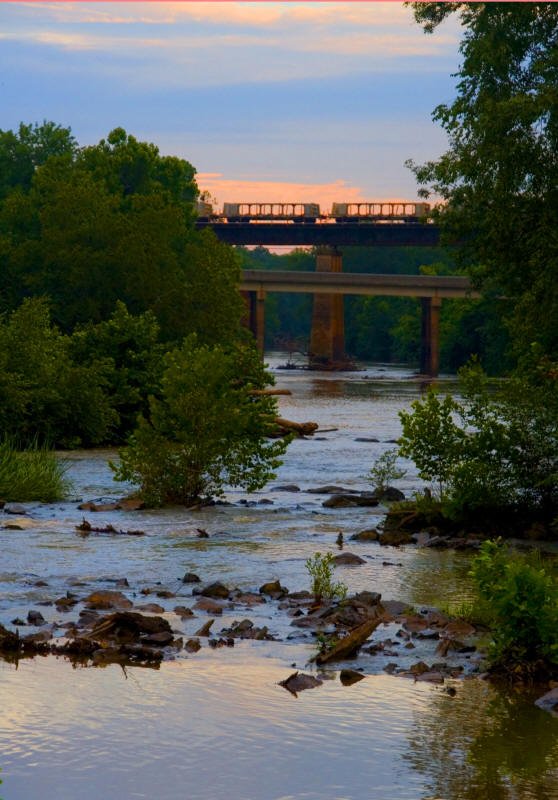
In the Haw River watershed, a lack of protective water quality regulations have degraded our rivers and inhibited our rights to fishable, swimmable, drinkable waters. The following policy goals seek to address these sources of pollution and provide support to communities and enforcement agencies to protect our limited resources. (Pictured right: Red Slide Park in Alamance County, Photo from Alamance Parks)
PFAS & 1,4-dioxane
Emerging contaminants including PFAS and 1,4-dioxane, discharged from industries and wastewater treatment facilities have contaminated drinking water supplies throughout the Cape Fear watershed. The Haw River basin has seen levels being discharged from industrial users at over 2.3 million parts per trillion (ppt) total PFAS. The Environmental Protection Agency has set Maximum Contaminant Levels for drinking water at no higher than 10 ppt for 3 PFAS. However, the levels in discharge have not been addressed.
● Direct NCDEQ to exercise already existing authority under federal and state laws to immediately require all NPDES dischargers sending effluent into drinking water supplies to:
○ Disclose all emerging contaminants in effluent
○ Require in NPDES permits, Technology-Based Effluent Limitations (TBELs) on all
discharges of PFAS or 1,4 dioxane
● Require ongoing monitoring of biosolids to ensure no land application exceeds limitations
● Direct the NC Environmental Management Commission to begin rule-making to set numeric limits on PFAS and 1,4-dioxane compounds in surface waters.
● Allocated $1 million in recurring funds the the Bernard Allen Fund, which has been depleted as this vital program has provided safe drinking water to families impacted by contaminated well water.
Nutrients, Sediment, Stormwater and Bacteria Pollution
Nonpoint nutrient, sediment, stormwater and bacteria pollution are major issues in the Haw River watershed, driven by industrial animal agriculture, urban stormwater runoff, development and forestry. Using our Swim Guide program, Haw River Assembly monitors several recreational swimming access for E.coli bacteria. Often, we have sample locations that surpass the EPA recommendation for recreational exposure. The following legislative recommendations target nutrient and bacteria pollution in the watershed.
● Increased funding for wastewater infrastructure upgrades - Failing wastewater infrastructure is a main contributor to bacteria reaching our streams, particularly in urban areas.
● Require public notification for Sanitary Sewer Overflows - We recommend a digital opt-in notification system (email or text) for the public to be notified of any sanitary sewer overflow in their area within 24 hours of the spill.
● Incentivize Green Stormwater Infrastructure - Green stormwater infrastructure provides an opportunity to focus on volume and velocity, water quality and quantity, which limits sediment and nutrient loads from development sites. This practice must be incentivized at the construction level in order to effectively and efficiently manage both construction and post construction stormwater.
● Harmful Algal Blooms (HABs) - Appoint an interagency task force to develop recommendations on defining, monitoring and responding to HABs and propose numeric criteria for nutrients, chlorophyll-a and cyanotoxins to reduce potential HABs and provide state funding for cyanobacteria/HAB mitigation and removal strategies.
● Stormwater Mitigation on Redevelopment Projects - Repeal or significantly amend Session Law 2018-145 Section 26 ( G.S. 143‐214.7(b2) and (b3)) to allow local governments the authority to require stormwater mitigation efforts on redevelopment projects if they so choose.
● Public Notice for Approval of Erosion and Sediment Control Plans and Stormwater - Permits - Issuances of certificate of coverage for Erosion and Sediment Control Plans and post-construction stormwater management plans should require public notice.
Industrial Animal Agriculture
Industrial Animal agriculture has been largely unregulated in North Carolina, especially in the poultry industry. This has left small farmers prioritizing regenerative methods to protect soil, water, and community health with limited resources from state assistance programs. Furthermore, taking steps to regulate industrial animal production in North Carolina will boost our state’s resiliency as climate change impacts threaten to flood facilities and contaminate surface waters that our communities depend on.
● Funding to Support Farmers:
○ Increase Funding for Soil and Water Cost-Share Programs - The Agricultural Cost Share Program typically receives as much as $20 million in requests for $4 million in annual funding statewide. We recommend doubling that to meet demand. ($8 million recurring)
○ Livestock exclusion from waterways - We suggest establishing a fund of $1 million recurring annually to help farmers install livestock exclusion fencing and alternative water sources. ($1 million recurring)
● Oversight of the Poultry Industry - The poultry industry in North Carolina has little regulation, which leads to unchecked amounts of nutrients and bacteria from these facilities polluting our state’s waterways. We request these actions:
○ Poultry Study Bill - to understand the impacts of poultry waste on our state waterways
○ Animal Agriculture Resilience Planning - to remove facilities within the 100 year floodplain and prevent new construction of facilities within the 500 year floodplain.
○ Nutrient Waste Utilization Plans - to be submitted to DEQ for approval and prohibit land application of poultry waste within 100 ft of surface waters.
Confronting Environmental Justice Issues
● Codify DEQ’s existing authority to deny a permit if the cumulative impact, when coupled with existing environmental or health concerns, would cause a disproportionate, adverse impact on a community protected by Title VI of the Civil Rights Act of 1964.
Recreation and Access to Natural Spaces:
● Remove failing dams - Failing dams are a major hazard in flooding events, as we have seen over the past year with Tropical Storm Chantal and Hurricane Helene in western NC. Our watershed has several dams that have been designated as high hazards, and we will be advocating for their removal.
● Improvements on the Haw River Trail - The Haw River Trail has become a destination for outdoor recreation from people all across the state. However, many river accesses along the trail are not easily accessible or pose significant risk to paddlers. We will be advocating for funds to be allocated to improve existing river accesses and create new accesses in Rockingham and Guilford counties.